
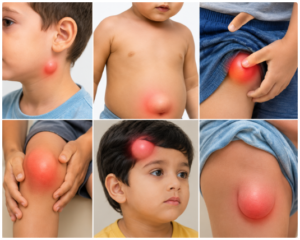
 Discovering a lump or swelling on your child’s body can be alarming for any parent. While most lumps and swellings in children are harmless and often related to infections, injuries, or developmental conditions, some may require prompt medical attention.
Understanding the common causes and warning signs can help parents know when to seek expert evaluation.
What Causes Lumps and Swellings in Children?
Lumps and swellings can develop anywhere on a child’s body, including the neck, abdomen, groin, chest, scalp, or limbs. They may be present from birth or appear later during childhood. Some common causes include:
Enlarged Lymph Nodes
Lymph nodes often become swollen when a child has a throat infection, cold, ear infection, or viral illness. These swellings are usually soft, movable, and may gradually reduce in size after recovery.
Hernias
A hernia occurs when an internal organ or tissue protrudes through a weak area in the abdominal wall. In children, hernias commonly appear as a swelling in the groin or around the belly button and may become more noticeable when the child cries or strains.
Cysts and Benign Lumps
Conditions such as dermoid cysts, sebaceous cysts, and lipomas can present as painless lumps beneath the skin. Although usually non-cancerous, they may require surgical removal if they enlarge or cause discomfort.
Hydrocele
A hydrocele causes swelling in the scrotum due to fluid accumulation around the testicle. It is commonly seen in infants and young boys.
Warning Signs Parents Should Not Ignore
While most childhood swellings are benign, medical evaluation is recommended if a lump:
- Continues to grow in size
- Persists for more than a few weeks
- Causes pain or tenderness
- Appears red, warm, or infected
- Restricts movement or daily activities
- Is associated with fever, weight loss, or fatigue
- Appears in the abdomen or groin and becomes difficult to push back
These symptoms may indicate an underlying condition that requires specialized treatment.
How Are Lumps and Swellings Diagnosed?
A pediatric surgeon will perform a detailed examination and review the child’s medical history. Depending on the location and nature of the swelling, investigations may include:
- Ultrasound examination: Helps determine the size, location, and nature of the lump
- Blood tests: Identify signs of infection, inflammation, or other underlying medical conditions.
- X-rays or advanced imaging: Provide detailed images of deeper structures when required.
- Biopsy: A small tissue sample may be examined under a microscope to confirm the diagnosis.
Early diagnosis helps identify the exact cause and guides appropriate treatment.
Treatment Options
Treatment depends on the underlying condition. Some swellings resolve on their own, while others may require medication, observation, or pediatric surgical intervention. Conditions such as hernias, hydroceles, and certain cysts often benefit from timely surgical treatment to prevent future complications.
Expert Care for Childhood Lumps and Swellings in Jaipur
If your child has a persistent lump, swelling, or unexplained mass anywhere on the body, timely evaluation is essential. Dr. D. Bhadoo, AIIMS-trained Pediatric Surgeon in Jaipur, specializes in the diagnosis and treatment of hernias, hydroceles, cysts, lymph node swellings, and other pediatric surgical conditions, providing safe and child-friendly care at Kidsurg.