
Understanding Hydrocele in Children?
A hydrocele is a condition in which fluid collects around the testicle, causing the scrotum to swell. It is typically painless and often looks more alarming than it actually is. Hydroceles are commonly seen in newborn boys and young children, and in many cases, the condition is harmless and treatable.
What causes a hydrocele in a child?
During fetal development, a baby boy’s testicles descend from the abdomen into the scrotum through a small tunnel called the inguinal canal. Normally, this canal closes before birth.
A hydrocele occurs when:
- The canal does not close properly, allowing fluid to pass into the scrotum, or
- Fluid remains trapped around the testicle even after the canal closes.
Types of Hydrocele
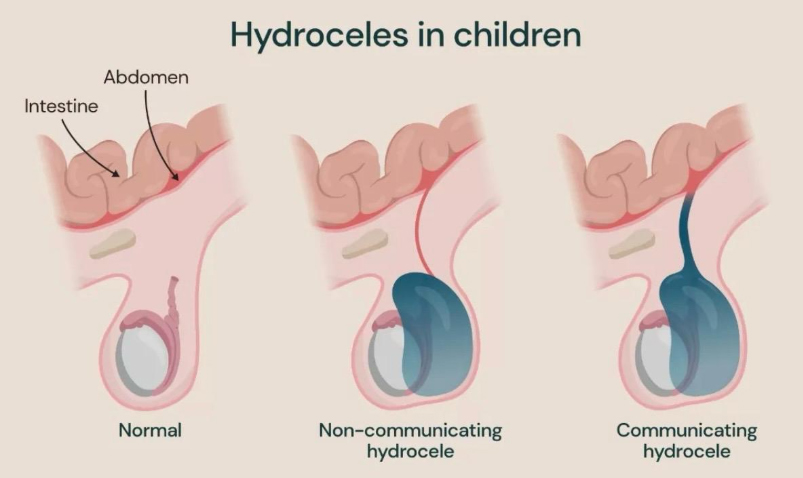
Communicating hydrocele:
- The canal stays open.
- Swelling may change in size throughout the day.
- Often more noticeable during crying, straining, or physical activity.
Non-communicating hydrocele:
- The canal is closed.
- Fluid stays trapped around the testicle.
- Many resolve naturally by age of 1 to 2 years.
What are the symptoms of a hydrocele in a child?
- Painless swelling of the scrotum
- Swelling may fluctuate (in communicating type)
- No significant change in eating, activity, or behavior of child
- Rarely causes discomfort
While hydrocele itself is harmless, swelling that resembles it may sometimes indicate other conditions such as inguinal hernia, which requires prompt attention and surgery.
How is a hydrocele diagnosed in a child?
A pediatric surgeon typically diagnoses hydrocele through:
- Physical examination, to assess swelling and fluid movement
- Transillumination, where light is passed through the scrotum to detect trapped fluid
- Rarely, an ultrasound may be needed to rule out other issues when in doubt.
Diagnosis is usually straightforward and painless.
How is a hydrocele treated in a child?
In infants and young children, many non-communicating hydroceles resolve on their own within the first 12-24 months. Doctors often advise watchful waiting during this period.
Surgery is necessary if:
- Hydrocele persists beyond age of 2 years
- Swelling continues to increase
- It is a Communicating hydrocele
- There is discomfort
- Inguinal Hernia is suspected
Persistent hydroceles are treated with Surgery under General Anaesthesia, which is safe, quick, and performed by pediatric surgeons. Most children recover fast and can go to school within 3 to 7 days.
Conclusion:
Hydrocele may look alarming, but it’s one of the most manageable pediatric surgical condition. Early evaluation by a pediatric surgeon offers clarity, reassurance, and the right guidance for treatment.

Frequently Asked Questions (FAQs)
1. Is hydrocele in children dangerous?
Most hydroceles are harmless and painless, but evaluation is important to rule out conditions like hernia, which may need immediate treatment.
2. Does hydrocele go away on its own?
Yes, many cases of non-communicating hydrocele especially in infants, resolve naturally by 1–2 years of age without intervention.
3. When does a child with hydrocele need treatment?
Communicating hydroceles always need surgery. Also, surgery is required if the swelling persists beyond age 2, keeps increasing, causes discomfort, or if an inguinal hernia is suspected.
4. How is hydrocele diagnosed?
Diagnosis is mostly clinical through a physical exam, sometimes supported by transillumination or ultrasound to confirm fluid presence and rule out hernia.
5. Is surgery for hydrocele safe and effective?
Yes. Hydrocele surgery is a simple, routine, and safe procedure performed by pediatric surgeons, with quick recovery and excellent outcomes.
Watch here: https://www.instagram.com/p/DT9lPp9iNLc/