
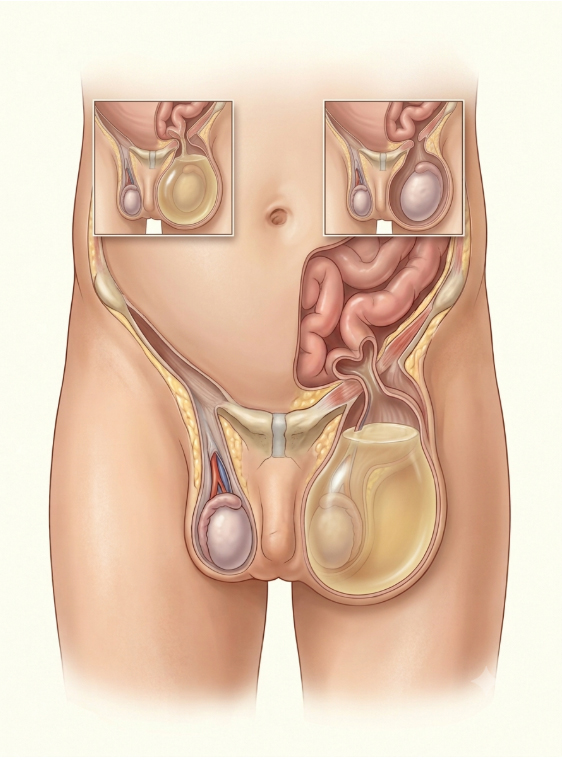
 What is a Hydrocele?
The testicles develop inside the abdomen during fetal life and gradually descend into the scrotum before birth. During this process, they pass through a small channel called the processus vaginalis, which normally closes after the testicles reach the scrotum.
If this passage remains partially or completely open, fluid can collect around the testicle, resulting in a hydrocele. It usually doesn’t affect urination, hormone production, or future fertility. However, some hydroceles remain after infancy or are associated with an inguinal hernia, requiring surgical correction.
Hydroceles are more commonly seen in:
- Premature babies
- Low birth weight babies
- Children with associated inguinal hernia
- Rarely, following infection or trauma in older children
Parents should know that hydroceles are congenital conditions in most infants and are not caused by diaper use, physical activity, or improper care.
What are the Different Types of Hydrocele?
Hydroceles are broadly classified into two types.
- Non-Communicating Hydrocele: In this type, the passage between the abdomen and scrotum has closed, but fluid remains trapped around the testicle.
- Communicating Hydrocele: A communicating hydrocele occurs when the passage remains open, allowing fluid to move between the abdomen and the scrotum.
The swelling may change in size throughout the day and it doesn’t resolve without surgery.
Symptoms of Hydrocele
The most common symptom is a painless swelling on one or both sides of the scrotum.
Other features may include:
- Soft swelling around the testicle
- Swelling that appears larger during the day
- Scrotal enlargement that becomes smaller after rest
- Smooth, fluid-filled swelling
- No pain in most cases
- Occasional feeling of heaviness in older children
- Swelling noticed during bathing or diaper changes
Any persistent scrotal swelling in a child should be examined by a pediatric surgeon.
When Should You Consult a Pediatric Surgeon?
Parents should seek medical evaluation if:
- The hydrocele persists beyond one year of age
- The swelling increases in size
- The scrotum becomes painful or red
- The swelling changes significantly throughout the day
- A groin swelling develops along with the hydrocele
- The diagnosis is uncertain
Early evaluation helps determine whether the swelling is a hydrocele, an inguinal hernia, or another scrotal condition.
How is a Hydrocele Diagnosed?
Diagnosis usually begins with a detailed medical history and physical examination.
During the consultation, Dr. D. Bhadoo evaluates:
- The size and consistency of the swelling
- Whether the swelling changes during examination
- The position of both testicles
- Signs of an associated inguinal hernia
In selected cases, additional investigations may include:
- Scrotal ultrasound
- Ultrasound of the groin if hernia is suspected
These tests help confirm the diagnosis and exclude other conditions affecting the scrotum.
Treatment Options for Hydrocele
Treatment depends on the child’s age and the type of hydrocele.
- Observation: Most non-communicating hydroceles in infants disappear naturally within the first 12 to 24 months. Regular follow-up is recommended to monitor the size of the swelling and ensure normal testicular development.
- Hydrocele Surgery: If the hydrocele persists beyond infancy, becomes larger, or is identified as a communicating hydrocele, surgery is advised. During hydrocele surgery, the abnormal communication is closed, and the accumulated fluid is drained. If an associated inguinal hernia is present, it is repaired during the same procedure. The operation is performed under general anesthesia and has an excellent success rate.
What Parents Should Expect During Hydrocele Surgery
Hydrocele repair is generally performed as a daycare procedure.
The surgery usually takes around an hour, and most children are discharged on the same day or next day after recovering from anesthesia.
Parents receive clear instructions regarding fasting, pain management, wound care, bathing, activity restrictions, and follow-up before discharge.
Recovery After Hydrocele Surgery
Recovery following hydrocele repair is usually straightforward.
Most children experience:
- Mild swelling around the surgical site
- Minimal postoperative discomfort
- Early feeding after surgery
- Return to routine activities within a few days
- Follow-up examination to monitor healing
The incision heals gradually, and children typically resume school and play within one to two weeks.
What Happens if a Hydrocele is Left Untreated?
Many infant hydroceles resolve naturally, but persistent or communicating hydroceles should not be ignored.
Possible complications include:
- Progressive enlargement of the swelling
- Associated inguinal hernia
- Cosmetic concerns
- Discomfort due to increasing size
- Delayed diagnosis of other scrotal conditions
Timely treatment helps prevent these problems while preserving normal testicular development.
Why Choose Dr. D. Bhadoo for Hydrocele Treatment in Jaipur?
Children with hydrocele benefit from evaluation by a pediatric surgeon who understands congenital scrotal conditions and their management well.
Parents choose Dr. D. Bhadoo for hydrocele treatment in Jaipur because of:
- Specialized expertise in Pediatric Surgery
- Extensive experience treating hydroceles and inguinal hernias
- Child-friendly evaluation
- Individualized treatment recommendations
- Expertise in daycare hydrocele surgery
- Modern surgical techniques with minimal scarring
- Comprehensive counselling for parents
- Dedicated postoperative follow-up