
What is an Inguinal Hernia?
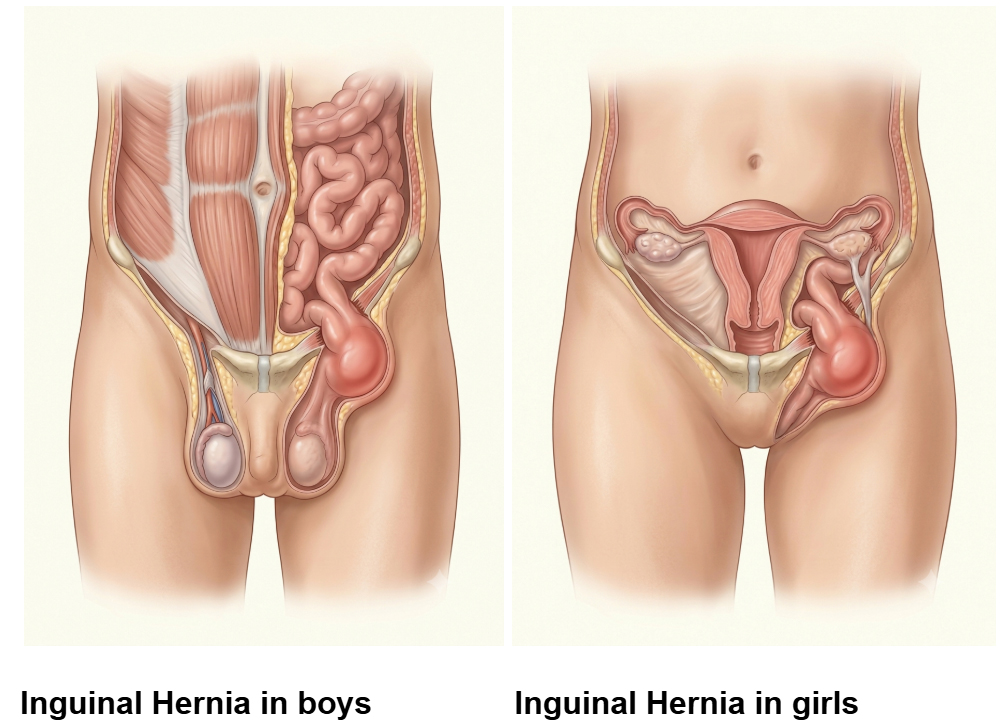
Before birth, the testicles descend from the abdomen into the scrotum through a small passage called the inguinal canal. In girls, a similar passage exists within the groin. Normally, this opening closes before birth.
When this opening remains open, abdominal contents such as a loop of intestine or omental fat can pass through it, forming an inguinal hernia.
This condition may affect one or both sides of the groin and is more commonly seen in boys, premature and low birth weight babies. Although Inguinal hernia is present from birth, the swelling may not become noticeable until weeks or months later.
How is an Inguinal Hernia Different from a Hydrocele?
Parents often confuse an inguinal hernia with a hydrocele because both may cause swelling in the groin or scrotum.
The main difference is that:
- An inguinal hernia contains abdominal contents such as intestine and requires surgery.
- A hydrocele contains only fluid around the testicle and many of these cases resolve naturally.
A pediatric surgeon can distinguish between the two conditions during a clinical examination.
Symptoms of an Inguinal Hernia
The most common sign is a swelling in the groin or scrotum that may appear and disappear.
Other symptoms may include:
- A soft lump in the groin
- Swelling that becomes more prominent during crying or coughing
- Swelling that reduces or disappears when the child relaxes or lies down
- Irritability in infants
- Groin discomfort in older children
- Sudden painful swelling that does not disappear indicating obstructed hernia
A persistent groin swelling should always be evaluated by a pediatric surgeon.
When Should You Consult a Pediatric Surgeon?
Parents should seek medical advice if their child has:
- A swelling in the groin or scrotum
- A lump that becomes bigger during crying
- Pain or tenderness over the swelling
- Vomiting associated with a groin swelling
- Redness or firmness over the lump
- A swelling that cannot be pushed back into the abdomen (irreducible hernia)
What Causes an Inguinal Hernia?
An inguinal hernia develops because the opening between the abdomen and groin fails to close completely before birth.
Certain children have a higher risk, including:
- Premature babies
- Male infants
- Children with a family history of hernia
- Babies with undescended testis
- Children with connective tissue disorders
Parents should know that congenital inguinal hernia is not caused by lifting heavy objects, excessive crying, or normal childhood activities.
How is an Inguinal Hernia Diagnosed?
Diagnosis is usually straightforward and begins with a detailed history and physical examination.
During the consultation, Dr. D. Bhadoo will assess:
- The location of the swelling
- Whether the swelling is reducible
- Both sides of the groin
- The scrotum or labia
- Signs of complications such as incarceration
Most children do not require imaging. However, ultrasound may occasionally be advised if the diagnosis is uncertain or another condition is suspected.
Treatment Options for Inguinal Hernia
Unlike some pediatric conditions, an inguinal hernia cannot be treated with medicines or home remedies.
- Observation: Observation is not recommended because the opening will not close on its own and there is always a risk that the intestine may become trapped.
- Inguinal Hernia Surgery: It is the only effective treatment. During the procedure, the abnormal opening is identified and securely closed to prevent abdominal contents from protruding again. The operation is performed under general anesthesia and is one of the most commonly performed pediatric surgical procedures, with excellent long-term outcomes.
- Laparoscopic Hernia Repair: In selected children, laparoscopic inguinal hernia surgery may be recommended. This minimally invasive technique uses tiny incisions and a camera to repair the hernia while offering benefits such as:
- Smaller scars
- Less postoperative discomfort
- Faster recovery
- Better visualization of both groins
- Early return to normal activities
The most appropriate surgical approach is decided by pediatric surgeon after evaluating your child.
What Parents Should Expect During Surgery
Pediatric inguinal hernia surgery can be performed as a daycare procedure.
The operation generally takes around an hour, and most children return home on the same or next day after recovering from anesthesia.
Parents receive detailed guidance regarding fasting, anesthesia, wound care, feeding, pain management, and follow-up before discharge.
Recovery After Inguinal Hernia Surgery Most children recover rapidly following surgery. Parents can expect:
- Mild discomfort for a few days
- Small surgical dressings
- Walking and gentle activity within a day
- Return to school in about one week
- Follow-up visits to monitor healing and detect recurrent hernia
Children usually resume their normal routine quickly with very few restrictions.
What Happens if an Inguinal Hernia is Left Untreated?
Because an inguinal hernia does not resolve on its own, delaying treatment increases the risk of complications.
Possible complications include:
- Incarcerated hernia (trapped intestine)
- Strangulated hernia (reduced blood supply to the intestine)
- Severe pain and swelling
- Vomiting
- Intestinal obstruction and perforation
- Emergency surgery
Prompt surgical repair greatly reduces the likelihood of these serious complications.
Why Choose Dr. D. Bhadoo for Inguinal Hernia Treatment in Jaipur?
Children with inguinal hernias require specialized care from a pediatric surgeon familiar with the unique anatomy and surgical needs of newborns, infants and children.
Parents choose Dr. D. Bhadoo for inguinal hernia treatment in Jaipur because of:
- Specialized expertise in Pediatric Surgery
- Extensive experience treating pediatric hernias
- Child-friendly consultation and examination
- Personalized treatment for every child
- Advanced open and laparoscopic surgical techniques
- Safe daycare surgery with modern anesthesia
- Comprehensive counselling for parents
- Dedicated postoperative follow-up
Every child receives individualized care focused on safety, comfort, and long-term outcomes.