
Not every swelling in a child’s groin is serious, but it should never be ignored. Parents often notice a small bulge near the groin or scrotum while bathing the child, during crying, coughing, or straining. Sometimes the swelling disappears when the child relaxes or lies down, making it even more confusing. One of the most common causes of such swelling in children is an inguinal hernia.
Understanding the condition early can help prevent complications and ensure timely treatment.
What Is an Inguinal Hernia?
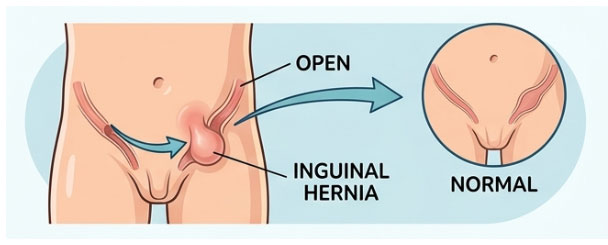
An inguinal hernia occurs when a small part of the intestine or abdominal tissue pushes through a weak area in the lower abdominal wall near the groin. In children, this usually happens because of a small passage that fails to close properly after birth.
This condition is commonly seen in:
- Newborn babies
- Premature infants
- Boys more than girls
In boys, the swelling may extend into the scrotum, while in girls it may appear as a swelling near the labia.
How Does it Look?
Parents may notice:
- A soft bulge in the groin
- Swelling that becomes more visible during crying or coughing
- Swelling that disappears during sleep or when the child relaxes
- Increase in size over time
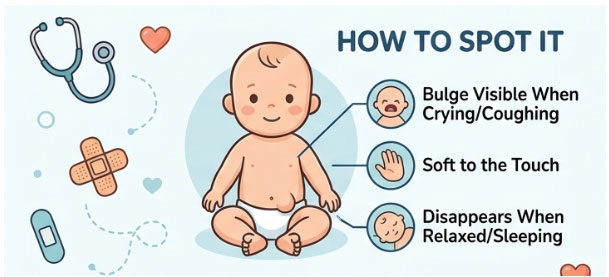
Usually, the swelling is painless in the beginning. Many children continue playing normally, which is why parents may delay consultation.
Is Every Groin Swelling a Hernia?
No. Other conditions can also cause swelling in the groin region, such as:
- Hydrocele
- Enlarged lymph nodes
- Undescended testis
- Femoral hernia
- Local infection or cyst
A pediatric surgeon can differentiate these conditions after examination.
When Should Parents Worry?
A hernia becomes dangerous if the intestine gets trapped inside the swelling. This is called an incarcerated hernia and needs urgent treatment.
Seek immediate medical attention if:
- The swelling becomes hard or painful
- The child is continuously crying
- Vomiting occurs
- The swelling does not disappear on lying down
- The child develops abdominal distension
- Redness appears over the swelling
In such situations, delaying treatment can affect the blood supply to the intestine and can lead to
How Is Hernia Diagnosed?
Most pediatric hernias can be diagnosed by a good clinical examination. In some cases, ultrasound may be advised, especially if there is doubt about diagnosis.
What Is the Treatment?
Unlike some conditions that improve with medicines, inguinal hernia does not go away on its own. Surgery is the only treatment for an inguinal hernia.
The procedure is usually:
- Short and safe
- Performed under general anesthesia
- Associated with quick recovery
Modern pediatric surgical techniques allow minimal discomfort and faster healing. In many children, hernia repair can also be performed using laparoscopic (keyhole) surgery. In this technique, the surgeon uses a tiny camera and small instruments inserted through very small cuts to repair the hernia. Laparoscopic surgery offers benefits such as:
- Smaller scars
- Less post-operative pain
- Faster recovery
Another advantage of laparoscopy is that the surgeon can check the opposite side for a hidden hernia during the same procedure, helping prevent future problems.
The choice between open and laparoscopic surgery depends on the child’s age, type of hernia, and the pediatric surgeon’s evaluation. Both methods are safe and effective when performed by experienced hands.
Can Hernia Come Back After Surgery?
Recurrence after pediatric hernia surgery is uncommon. Most children recover completely and return to normal activities within a few days.
Final Words
A groin swelling in a child may look small, but it should always be evaluated by a pediatric surgeon. Early diagnosis helps prevent complications and ensures safe treatment before emergencies develop.
If you notice a swelling in your child’s groin that appears during crying, coughing, or straining, do not ignore it. Timely consultation can make treatment simpler, safer, and stress-free for both the child and parents.