
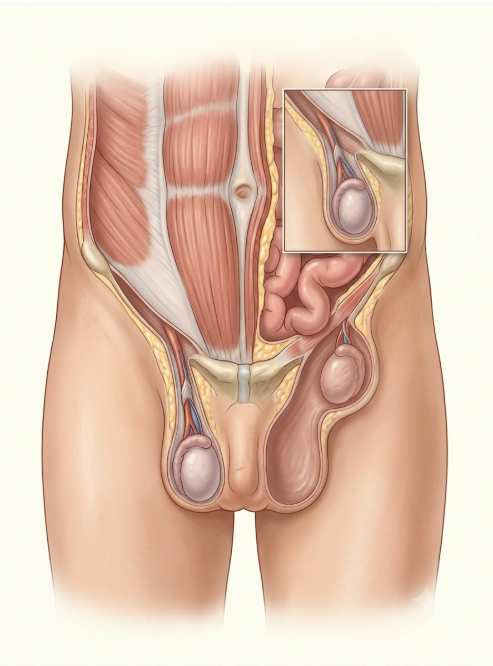
 What is an Undescended Testis?
During fetal development, the testicles form inside the abdomen and gradually move downward into the scrotum before birth.
An undescended testis occurs when this natural process is incomplete, leaving the testicle within the abdomen, the inguinal canal, or another abnormal location. The condition may affect one testicle (unilateral undescended testis) or both (bilateral undescended testes). It is more frequently seen in premature infants and babies with a low birth weight.
A normally positioned testicle is important for its optimal growth, hormone production, and future fertility.
Is an Undescended Testis Different from a Retractile Testis?
Yes. These two conditions are often confused but require different management.
An undescended testis remains outside the scrotum because it has not completed its normal descent and usually requires surgery.
A retractile testis, however, can move into and out of the scrotum due to an active muscle reflex. It usually does not require surgery but should be monitored periodically by a pediatric surgeon.
Accurate diagnosis is essential because the treatment for each condition is different.
Symptoms of an Undescended Testis
Most children with cryptorchidism do not experience pain.
Parents may notice:
- One or both testicles missing from the scrotum
- An empty or underdeveloped side of the scrotum
- Difference in size of the two halves of the scrotum
- A testicle that can be felt in the groin
- Asymmetrical appearance of the scrotum
The condition is usually detected during a newborn examination or routine pediatric check-up. Sometimes parents notice it during bathing or clothing the child.
When Should You Consult a Pediatric Surgeon?
Parents should arrange an evaluation if:
- One or both testicles are absent from the scrotum after birth
- The testicle has not descended by 3 months of age
- A previously descended testicle appears to move permanently out of the scrotum
- The child develops swelling or discomfort in the groin
- There is uncertainty about the position of the testicle during routine examination
Early consultation allows treatment to be planned at the most appropriate age.
What Causes an Undescended Testis?
The exact cause of cryptorchidism is not always known.
Several factors may increase the likelihood of an undescended testis, including:
- Premature birth
- Low birth weight
- Family history of undescended testes
- Hormonal imbalance during fetal development
- Certain genetic conditions
- Disorders affecting testicular development
In most cases, the condition develops before birth and is unrelated to anything parents did during pregnancy.
How is an Undescended Testis Diagnosed?
Diagnosis usually begins with a careful physical examination performed by a pediatric surgeon.
During the consultation, the doctor evaluates:
- Whether the testicle can be felt in the groin
- The position of the opposite testicle
- The development of the scrotum
- Whether one or both testes are affected
If the testicle cannot be felt, additional investigations may include:
- Ultrasound in selected cases with ambiguous genitalia.
- Diagnostic laparoscopy for a non-palpable testis
- Blood tests or genetic evaluation when both testes are absent or to rule out other associated abnormalities.
These investigations help determine the exact location of the testicle and guide treatment.
Treatment Options for an Undescended Testis
Management depends on the child’s age and the location of the testicle.
- Observation During Early Infancy: Some testes descend naturally during the first few months after birth. If descent has not occurred by 3 months of age, further spontaneous movement is unlikely, and surgical correction is usually advised.
- Orchiopexy (Undescended Testis Surgery): It is the standard treatment for an undescended testis. During this procedure, the surgeon carefully mobilizes the testicle and secures it inside the scrotum or any position above to that preserving its blood supply and vas deferens. This may help normal testicular growth, facilitates future examination, and lowers the risk of complications associated with untreated cryptorchidism.
- Laparoscopic Surgery: If the testicle is located inside the abdomen, laparoscopic orchiopexy may be recommended. Using a camera and specialized instruments inserted through tiny incisions, the surgeon can accurately locate and reposition the testicle with minimal tissue trauma.
What Parents Should Expect During Surgery?
Undescended testis surgery is performed under general anesthesia.
The procedure generally takes between an hour to one and a half, depending on the position of the testicle. Most children are discharged on the same day after they have recovered from anesthesia.
Parents receive detailed instructions regarding fasting, postoperative care, medications, bathing, activity restrictions, and follow-up visits before leaving the hospital.
Recovery After Orchiopexy
Children usually recover quickly following orchiopexy.
Recovery typically includes:
- Mild discomfort for a few days
- Small surgical dressings
- Return to feeding soon after surgery
- Limited strenuous activity for a short period
- Follow-up examination to assess healing and testicular position
Most children return to school and routine activities within one to two weeks.
What Happens if an Undescended Testis is Left Untreated?
Leaving an undescended testis untreated may increase the risk of future health problems.
Potential complications include:
- Reduced fertility
- Testicular torsion
- Obstructed inguinal hernia
- Trauma to the abnormal testicle
- Increased risk of testicular cancer later in life
- Poor testicular growth
Early orchiopexy significantly reduces these risks and supports healthier long-term outcomes.
Why Choose Dr. D. Bhadoo for Undescended Testis Treatment in Jaipur?
Managing cryptorchidism requires specialized knowledge of pediatric anatomy and child-specific surgical techniques.
Parents choose Dr. D. Bhadoo for undescended testis treatment in Jaipur because of:
- Specialized expertise in Pediatric Surgery
- Extensive experience treating congenital urological conditions
- Expertise in open and laparoscopic orchiopexy
- Child-friendly consultation and examination
- Individualized treatment planning
- Modern surgical facilities
- Comprehensive counselling for parents
- Dedicated long-term follow-up